Laundry Detergent vs Laundry Soap for Your Washer
When choosing between laundry detergent and laundry soap, know detergent uses synthetic surfactants and enzymes for superior stain removal. It stays effective even in hard water without forming scum.
Soap, made from natural fats and oils, can struggle with oily stains and hard water buildup. It often leaves residues that affect fabric softness and machine health.
Detergent suits modern machines and varied fabrics better, while soap may be gentler on sensitive skin and soft water. Explore these differences to find what best suits your washing needs.
Key Takeaways
- Laundry detergent contains synthetic surfactants and enzymes, providing superior stain removal compared to natural soap made from saponified fats and oils.
- Soap forms insoluble scum in hard water, reducing cleaning efficiency, while detergents remain soluble and effective in all water types.
- Detergents rinse cleanly with minimal residue, preserving fabric softness and machine health; soap can leave oily residue and cause buildup.
- Soap is generally gentler on sensitive skin due to natural ingredients, but detergents offer formulations suitable for sensitive fabrics and colors.
- Detergents are optimized for modern washing machines, including low-sudsing formulas, whereas soap can cause excess suds and machine clogging.
Laundry Soap vs Detergent: Side-by-Side Comparison
| Feature | Laundry Soap | Laundry Detergent |
|---|---|---|
| Primary Ingredients | Natural fats & oils (saponified) | Synthetic surfactants & enzymes |
| Performance in Hard Water | Forms scum, reduced efficiency | Remains effective, no scum |
| Stain Removal Power | Moderate, struggles with oily stains | Strong, targets grease & proteins |
| Machine Compatibility | May cause buildup in modern washers | Designed for high-efficiency machines |
| Residue on Fabrics | Can leave oily residue | Rinses clean with minimal residue |
| Skin Sensitivity | Generally gentler | Some formulas designed for sensitive skin |
| Environmental Impact | More biodegradable | Varies by formulation |
Ingredients of Laundry Soap vs Detergent

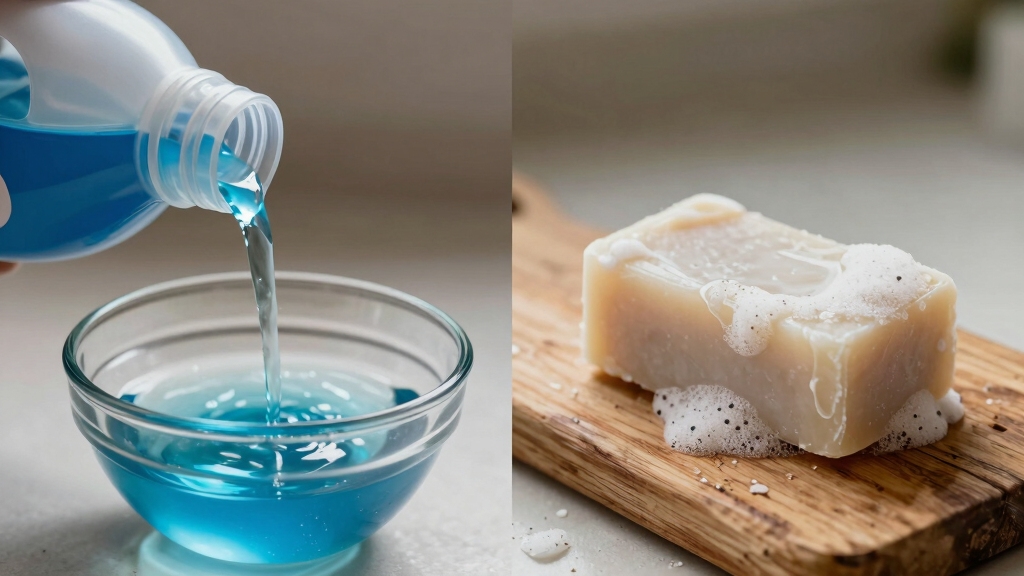
When you compare the ingredients of laundry soap and detergent, you’ll find they differ fundamentally in composition and production methods.
Laundry soap and detergent differ fundamentally in their ingredients and manufacturing processes.
Laundry soap primarily consists of natural fats and oils, such as coconut, olive, or castor oil, which undergo saponification with an alkali like sodium hydroxide to form organic soap molecules.
In contrast, laundry detergents are formulated with synthetic surfactants, enzymes, and various chemical agents designed for enhanced cleaning performance.
Detergents employ long-chain molecules and multiple surfactants to ensure water solubility and efficacy in diverse conditions.
Additionally, detergents often contain bleach and synthetic cleansing agents not present in soap.
Soap’s organic components contrast with the synthetic and chemically complex makeup of detergents, reflecting their distinct manufacturing processes and functional properties.
This fundamental difference defines their behavior and application in laundry cleaning.
Many modern detergents now incorporate plant-based, biodegradable ingredients to balance effective cleaning with environmental safety.
Why Detergent Cleans Better Than Soap?
You know, detergents really have an edge over soap when it comes to tackling those tough stains, like grass and grease.
It’s pretty fascinating how their enzymatic action and a mix of synthetic surfactants work together to break down grime.
Plus, when you’re dealing with hard water, detergents really shine. They prevent scum from forming, which is a huge bonus.
Soap, on the other hand, tends to react with the minerals in hard water and, as a result, loses its cleaning power.
Many modern detergents also avoid harsh chemicals like phosphates and parabens to be gentler on skin and the environment, making them a safer choice overall for sensitive skin.
Superior Stain Removal
Detergents outperform laundry soaps in stain removal by utilizing specialized enzymes and synthetic surfactants engineered to break down complex substances like grass, wine, and grease.
These enzymes target specific stain molecules, catalyzing their breakdown into smaller, water-soluble components that detergents then suspend, preventing redeposition onto fabrics.
Synthetic surfactants in detergents lower water’s surface tension more effectively than soap, enhancing penetration into textile fibers and loosening embedded dirt.
In contrast, soap relies on natural fatty acid salts that are less efficient at emulsifying oily or protein-based stains, especially under variable washing conditions.
Additionally, detergents often include multiple surfactants and boosters to tackle a wider range of stains, maintaining efficacy across temperatures.
Consequently, when confronting stubborn or diverse stains, detergents provide superior cleaning performance compared to traditional laundry soaps.
Moreover, many modern detergents are formulated to be biodegradable and non-toxic, contributing to environmental safety without compromising cleaning power.
Hard Water Efficiency
Although hard water presents challenges for many cleaning agents, laundry detergents maintain their effectiveness by preventing scum formation and optimizing surfactant performance.
When you use soap in hard water, minerals react with soap’s fatty acids, creating insoluble scum that reduces cleaning power and leaves residue on fabrics.
Detergents, formulated with synthetic surfactants and chelating agents, avoid this problem, ensuring consistent cleaning and protecting your washing machine over time.
However, it is important to avoid mixing certain cleaning agents like bleach and OxiClean, as their chemical reaction can produce toxic gases and reduce cleaning effectiveness.
| Feature | Laundry Soap | Laundry Detergent |
|---|---|---|
| Reaction with minerals | Forms scum, lowers efficiency | No scum, maintains surfactant action |
| Cleaning performance | Decreases in hard water | Stable across water types |
| Residue on fabrics | Leaves buildup, repels water | Minimal, rinses cleanly |
| Machine compatibility | Causes buildup, clogs pipes | Suitable for modern machines |
| Longevity of fabrics | Reduced due to residue | Preserves fabric integrity |
How Hard Water Affects Soap and Detergent?
When you use soap in hard water, it can be a bit of a hassle. You see, the soap reacts with the minerals in the water and forms this annoying soap scum. This scum isn’t just a nuisance; it really cuts down on how well the soap cleans.
Now, detergents have a different story. They’re designed with synthetic surfactants that just laugh in the face of those pesky minerals. Because of this, detergents keep working effectively, no matter what kind of water you’re using.
So, if you want reliable and consistent results in your laundry, detergents are definitely the way to go! However, hard water can also lead to mineral buildup that may cause soap scum formation on plastic surfaces, which requires regular cleaning to prevent damage.
Soap Scum Formation
Hard water markedly influences the effectiveness of soap by causing soap scum formation, a chemical reaction that reduces cleaning power.
When soap interacts with calcium and magnesium ions in hard water, insoluble salts form. These deposits, known as soap scum, adhere to fabrics and washing machines, lowering detergent efficiency and causing residue buildup.
Detergents, formulated with synthetic surfactants, avoid this reaction, maintaining cleaning efficacy.
| Impact Area | Soap in Hard Water | Detergent in Hard Water |
|---|---|---|
| Cleaning Power | Reduced due to scum buildup | Maintained by synthetic surfactants |
| Residue Formation | High, causes fabric stiffness | Low, rinses cleanly |
| Machine Health | Scum clogs pipes, damages parts | Prevents buildup, protects machine |
This reaction also explains why soap scum can cause sticky residue and reduced lathering during cleaning.
Understanding soap scum formation helps you choose the right product for hard water conditions.
Detergent Performance Stability
Typically, detergents maintain consistent cleaning performance regardless of water hardness because their synthetic surfactants don’t react with minerals like calcium and magnesium.
This stability guarantees detergents effectively emulsify and suspend soils without forming insoluble precipitates.
In contrast, laundry soap, composed of natural fatty acid salts, reacts with hardness ions to produce soap scum.
This reaction reduces available active agents and diminishes cleaning efficiency.
As a result, soap’s cleaning power declines in hard water conditions, leading to residue buildup on fabrics and washing machines.
Detergents’ formulations often include chelating agents or builders that sequester hardness minerals, preserving surfactant activity and optimizing stain removal.
Consequently, when you use detergents, you benefit from stable, reliable cleaning performance across varying water hardness levels.
Unlike soap, which suffers notable performance degradation in such environments.
Many effective detergents also contain chelating agents that bind calcium and magnesium ions to prevent residue and maintain cleaning power.
Water Type Compatibility
In regions with mineral-rich water, you’ll notice a distinct difference in how laundry soap and detergent perform.
Hard water contains calcium and magnesium ions that react with soap’s natural fatty acids, forming insoluble scum. This scum reduces soap’s cleaning efficiency by trapping dirt and leaving residues on fabrics.
In contrast, detergents contain synthetic surfactants designed to remain soluble in hard water, preventing scum formation. These surfactants effectively emulsify oils and suspend dirt, maintaining cleaning power regardless of water hardness.
Using detergent in hard water also protects your washing machine from buildup and clogs caused by soap scum.
Consequently, if you live in an area with hard water, opting for detergent will guarantee peak cleaning performance and machine longevity compared to traditional laundry soap.
Additionally, choosing commercial green cleaning products can provide an eco-friendly and non-toxic option that safeguards both your fabrics and the environment.
Which Works Better With Modern Washing Machines?
When you choose a cleaning agent for your modern washing machine, detergents clearly outperform soaps due to their formulation and compatibility with advanced appliance technology.
Detergents feature synthetic surfactants and enzymes that deliver effective cleaning with minimal suds, vital for high-efficiency front-loaders. In contrast, soaps generate excess suds and leave residues that can clog pipes and damage components.
Detergents also rinse thoroughly, preventing buildup inside the machine. Consider these points when selecting a product:
- Low sudsing formula optimizes washing cycles and prevents machine strain.
- Superior rinsing reduces residue accumulation, extending machine lifespan.
- Pre-measured detergent sheets enhance dosing accuracy and reduce waste.
Choosing detergents guarantees your modern washer operates efficiently and avoids maintenance issues related to soap buildup. Additionally, the advanced filtration systems in detergents help maintain cleaner internal components by minimizing deposit formation.
How Soap and Detergent Affect Fabric Softness and Residue?
Understanding how soap and detergent impact fabric softness and residue is essential for maintaining textile quality. Soap tends to leave an oily residue that attracts dirt, reducing fabric softness and causing buildup.
Detergents, with their synthetic surfactants, rinse more thoroughly, minimizing residue and preserving softness. This difference affects both your fabrics and washing machine performance.
The choice of cleaning agent influences not only fabric care but also how surfactants interact with water and oils, similar to how different surfactant types affect skin cleansing.
| Aspect | Soap | Detergent |
|---|---|---|
| Residue Type | Oily, water-repelling residue | Minimal, clean rinsing |
| Fabric Softness | Reduced due to residue buildup | Maintained or enhanced |
| Dirt Attraction | Residue attracts more dirt | Suspends dirt in water |
Choosing detergent helps you maintain fabric integrity and softness by preventing residue accumulation.
Environmental Impact of Soap and Detergent
Although both laundry soap and detergent serve the same cleaning purpose, their environmental impacts differ markedly due to their compositions.
Laundry soap, derived from natural fats and plant oils through saponification, breaks down more readily in the environment, minimizing pollution.
Laundry soap, made from natural fats and oils, decomposes easily and reduces environmental pollution.
Detergents contain synthetic surfactants and chemicals, some of which may persist and act as pollutants.
When choosing between them, consider these factors:
Biodegradability: Soap is more biodegradable, reducing waterway contamination risk.
Chemical Load: Detergents may introduce synthetic compounds that affect aquatic ecosystems.
Carbon Footprint: Concentrated soap formulas often generate less packaging waste and lower carbon emissions.
Understanding these distinctions helps you make an informed choice that balances cleaning efficiency with ecological responsibility.
Which Is Gentler on Sensitive Skin?
Laundry soap generally proves gentler on sensitive skin due to its natural composition of plant-based oils and fats.
These ingredients lack the synthetic chemicals and enzymes commonly found in detergents.
When you use laundry soap, you avoid exposure to synthetic surfactants, optical brighteners, and bleaching agents that can irritate skin.
Soap’s organic components, produced through saponification, tend to be biodegradable and less likely to disrupt the skin’s natural barrier.
In contrast, detergents contain multiple synthetic surfactants and enzymes designed for enhanced stain removal.
These agents increase the risk of allergic reactions and dryness.
If you have sensitive skin, choosing soap reduces contact with potential irritants.
However, it’s important to rinse thoroughly since soap residues can accumulate and may also cause minor irritation if not fully removed.
When Should You Choose Soap Over Detergent?
If you prioritize natural ingredients and gentleness on sensitive skin, you should choose soap over detergent in specific situations.
Soap’s biodegradable, plant-based composition minimizes irritation and environmental impact. However, it’s less effective in hard water and modern machines.
Consider soap when:
- Washing delicate fabrics or baby clothes, where chemical residues must be minimal.
- Dealing with soft water environments to avoid scum formation and residue buildup.
- Preferring eco-friendly, biodegradable cleaning agents that reduce synthetic chemical exposure.
Soap’s saponification process yields organic compounds that break down readily, reducing pollutant load. Yet, it produces more suds and residue, limiting use in high-efficiency washers.
Consequently, you select soap primarily for gentleness, environmental safety, and specific water conditions, while detergents excel in stain removal and machine compatibility.
How to Measure and Use Laundry Soap and Detergent?
When you measure and use soap or detergent, accuracy plays a critical role in achieving ideal cleaning results while protecting your fabrics and washing machine.
For laundry soap, use the manufacturer’s recommended amount, typically a bar or grated equivalent per load. Avoid excess to prevent residue buildup and machine clogging.
Detergent dosing varies by load size, soil level, and water hardness. Use the measuring cap to add precise amounts, especially with concentrated formulas.
Overuse of detergent can cause suds overflow and fabric stiffness, while underuse reduces stain removal efficiency. Pre-measured detergent sheets offer consistent dosing and reduce waste.
Always dissolve soap flakes fully before adding to the wash to avoid uneven cleaning. Follow washing machine guidelines to maintain peak performance and fabric integrity.
Frequently Asked Questions
Can Laundry Soap or Detergent Remove Pet Odors Effectively?
You’ll find that laundry detergents remove pet odors more effectively than laundry soaps.
Detergents contain enzymes and synthetic surfactants designed to break down organic compounds, including pet urine and dander molecules causing odors.
Laundry soaps, made from natural fats and oils, lack these specialized enzymes, so they’re less efficient at neutralizing strong pet smells.
For persistent pet odors, detergents provide superior cleaning power and odor elimination, especially in hard water conditions.
Are There Specific Detergents or Soaps for Baby Clothes?
Yes, you’ll find detergents and soaps formulated specifically for baby clothes.
These products use gentle, hypoallergenic ingredients, often fragrance-free or lightly scented, and avoid harsh chemicals or dyes to protect sensitive skin.
They’re typically free from optical brighteners and enzymes to minimize irritation.
Using these specialized formulas guarantees effective cleaning while maintaining fabric softness and reducing risks of allergic reactions or residue buildup that could harm your baby’s delicate skin.
How Do Laundry Soaps and Detergents Differ in Price?
You’ll generally find laundry soaps priced lower upfront due to their simple, natural ingredients and traditional production methods.
Detergents often cost more because they contain complex synthetic surfactants, enzymes, and chemicals requiring advanced manufacturing.
However, detergents’ concentrated formulas and superior cleaning efficiency can make them more cost-effective over time, especially with pre-measured dosing reducing waste.
Can Laundry Soap or Detergent Be Used for Hand Washing Only?
Think of hand washing like gardening. You want gentle tools that nurture rather than harsh chemicals that strip.
You can use laundry soap for hand washing because it’s milder, made from natural oils, and won’t irritate your skin.
Detergents, with their synthetic enzymes and surfactants, work too but might cause dryness or irritation if you’re sensitive.
For frequent hand washing, soap’s gentler nature suits you better, while detergent is powerful for occasional use.
Do Detergents or Soaps Have Different Shelf Lives?
Yes, detergents generally have longer shelf lives than soaps due to their synthetic composition, which resists degradation.
You’ll find detergents remain effective for several years if stored in a cool, dry place.
Soaps, made from natural fats and oils, can degrade or harden over time, especially if exposed to moisture.
To maximize shelf life, keep both products sealed and away from humidity, but detergents typically retain potency longer.
Making the Smart Choice Between Laundry Detergent vs Laundry Soap
When weighing washing wonders, detergent delivers distinct advantages with its dynamic cleaning power and adaptability to hard water and modern machines.
Soap, while simpler and softer on skin, struggles with residue and fabric feel. You’ll want to weigh water quality, skin sensitivity, and environmental effects when selecting.
Ultimately, detergent dominates due to its detailed design for dirt and durability, but soap still suits specific scenarios. Choose carefully to combine cleaning competence with care.